Thursday, February 19, 2015

HOW TO BLOW UP THE LEAFS PROPERLY ... IN TWO DIFFICULT STEPS.

Much ink has been shed lately, and much anguish expressed on the latest plight of the Toronto Maple Leafs. For the second season in a row, the Leafs have served up a second-half melt down that has removed them from contention for the playoffs, and put them in the running for a high draft pick. Such is the despair of Leafs' fans that it can be said, without hyperbole, that they have completely turned on this team and have now developed a genuine hatred for the blue and white.

It needs to be fixed. It needs to be fixed now. And I humbly offer my solution. The solution comes in two parts:

A)  Put all energy in developing the AHL Marlies.
B)  Put absolutely no energy or enthusiasm in developing the Leafs.

It sounds simple, but the plan is nuanced, and needs explanation.

A) Develop the AHL Marlies.

Over the past few seasons, the Marlies have put together winning and entertaining hockey. Twice in the last four seasons, they have gone deep in the AHL playoffs, not winning the championship, but coming close. The parent Leafs, in the same time period, have made the playoffs once, and made a dramatic and spectacularly awful exit at the hands of the Boston Bruins.

If playoff hockey matters, and it does, the Marlies have done the job masterfully and, for that, the ownership group, Maple Leafs Sports and Entertainment, must reward them. MLSE must promote the Marlies in their playoff drive and do all they can to ensure that the Marlies make the playoffs and go as far as they can. MLSE must market the Marlies as their marquee franchise: they must bring players from the Leafs' roster who can help the Marlies win. And they must put all planning and strategy for future success in the Marlies, not the Leafs.

Playoff success aside, the Marlies exist as the development team for the Leafs. In the earlier playoff runs, the Marlies made use of some of the current Leafs. They had a good young coach, Dallas Eakins, who was able to teach young players how to play winning hockey. MLSE must now see the Marlies as the team in which to put all resources and planning. Instead of worrying about finding a fitting coach for the Leafs, MLSE should invest a thorough and energetic search for the right coaching staff to work in the AHL, educating and developing the young players who currently play there, or will be playing there in the next few seasons, as the Leafs make use of low draft choices or trade for other organizations' best prospects.

And when those young prospects and draftees arrive, they should remain in the AHL with the Marlies for a minimum of four years. Why four years? Why not? Four years should bring in anywhere from four to six top young players through the draft. If the Leafs finish low in the NHL standings during those years, which I will discuss more fully in the next section, their first and second round choices will be high picks, and decent-to-outstanding players will come their way.

But MLSE must be careful how they draft. If they follow the Edmonton Oilers' model, and draft the "best players available" over a period of four years, they will have a roster of impressive names, but no real team. Therefore, the Leafs should not be blinded by the stats of top rated junior or international draftees, but should choose players with the right combination of "skill" and "character".

And these players must stay together with the Marlies, growing and learning and, hopefully, winning together. If the Marlies roster improves, and they go deep in the AHL playoffs, they will develop the so-called "culture of winning" so badly lacking with the Leafs. Winning begets winning, and confidence is created with success.

MLSE must market the Marlies as such a team. If MLSE gets the Toronto sports fans and media excited about them, and not the Leafs, then expectations rise for the Marlies and the young players and coaches on that team. When the time is right, four or perhaps five years down the road, MLSE should promote a cohort of Marlies up to the Leafs to be the core of the NHL team. They will still be young, they will be confident, they will be a cohesive group, and, most importantly, they will know how to win. They will be ready to compete at a high NHL level.

B) Downgrade the Leafs.

On first glance, this doesn't seem like a difficult thing to do. How does one downgrade something that is a chronic underachiever? But what is meant here is a fundamental shift in the priorities of MLSE, the Toronto sports media, and Toronto hockey fans.

We have been conditioned to follow the Leafs blindly and without question for generations. We have believed, sometimes correctly, most times incorrectly, that the Leafs' managers, coaches and players are among the elite, not just in the NHL, but in the world. We have been told that the Leafs are a financial and corporate success, and that, if we are patient, the team on the ice will follow suit.

We have been duped by a successive group of narrow-minded hucksters and con artists in fancy suits.

The Toronto Maple Leafs are only a financial success because those who buy tickets, either corporations or wealthy individuals who lock up season tickets year after year, have bought into the notion that the Leafs are "big league", and that attending a Leafs' game is part of being a high roller or a person "in the know" in Toronto.  MLSE does little to promote the Leafs: they don't need to.  And, as a result, they continually hire people in management positions who make decisions which presuppose that, because the Leafs are "big league", things have to be done a certain way.

The results of these decisions speak for themselves. There has been only one recent "winning" regular season, when the team made the playoffs. There has been no playoff success whatsoever for several season. Free agent signings, over the years, and blockbuster trades have brought in high priced players who have not flourished or developed at all, nor have they contributed in any way to the team's success. When was the last time the Leafs had a bona fide star player? When was the last or any time that the Leafs had a major star player, one who was among the elite in the league? There has never been a Maple Leaf equivalent to a Gretzky, Lemieux, Howe, Hull, Beliveau, Richard, Orr, Crosby, Ovechkin or Stamkos ..... never.  Players like Apps, Kennedy, Keon, Mahovlich, Sittler, McDonald, Clark or Salming have come close to superstardom, but have not quite reached it.

Yet, those superstar players are out there. They are few in number, but they always wind up somewhere else. It has always been that way. There is not only an absence of a culture of winning in Toronto, but there has never really been a culture of excellence either.

Year after year, though, the trades are made and the free agent signings are announced to much media attention and fan hopes. It has been a generational and continuous failure. And has been such a failure because the management, media and fans allow it to be so.

It must stop. We must pay less attention to the Leafs. And the key to this is in management's hands.

Just as I propose to allow four years for MLSE to place all their planning and expertise in the development of the AHL Marlies, I propose that MLSE put absolutely no emphasis in developing the NHL Leafs. The current Leafs' roster must be systematically disassembled: all players with the exception of three or four young players, must be sent packing in trades or buy outs. The trades should not be for any other teams' roster players, but only for draft choices or prospects from the other teams' development systems. And these prospects, as stated above, must play in the AHL for that time period.

The Leafs' roster, therefore, must be filled with veteran journeymen players, free agents who are looking for work, those who are cast-offs from other teams, those who can't find a place in another team's development plan, those who have suffered set-backs in their careers, either through injury or a loss of self-esteem, and who are looking for fresh starts. In other words, fill the Leafs with has-beens for the next four or five years. This will accomplish three important things.

First, it will make it easy for the Toronto media and Toronto fans to "fall out of love" with the Leafs. They will pay attention only because they like the sweaters. And they will look for another place to put their loyalty, which will be the Marlies.

Second, a roster of less-than-stellar players, those with no real or inflated expectation of success, will ensure that the Leafs will finish low in the league standings for the next few years. That ensures higher draft choices, and, therefore, access to more promising young players .... for the Marlies. No young draftees should play for the Leafs until they have paid their dues and achieved success in the AHL.

Thirdly, a roster of less-than-stellar players will eventually ensure that the Leafs operate under whatever salary cap exists. Down the road, a low salary cap means that, when the young Marlies stars are ready to be promoted en masse to the NHL, there will be money to pay them according to their worth and keep them in the organization. And furthermore, room in the salary cap will mean that, in five or six years, when the Leafs prove that they are ready to challenge for the Stanley Cup, there will be funds available to allow them to make decisions regarding free agents, players who will be able to "fill in the gaps" needed to turn the team into a contender.

Thus, a complete paradigm shift needs to happen. Toronto must become an AHL town for a few years, and the fans and media must get behind it. And Toronto must all but ignore the Maple Leafs for the same time period. It is almost like believing that the Maple Leafs have been removed from the NHL, only to re-emerge a few years later, like an expansion team, with a completely new outlook, completely new expectations, and a completely new culture.  The minor league must now become big league, and the major league must all but disappear from our consciousness.

This is the only way.


Monday, February 16, 2015

OF MUMUS AND MOJITOS

This entry is dedicated to our good friend Deb, who suggested the topic.

There is a tradition at the Playa Costa Verde which we follow with a reverence usually displayed at religious events. Every day, where possible, at or around 4 pm, we gather at the Aqua Bar to participate in what we call a "Board Meeting." Attendance at Board Meetings is optional, but most of us wouldn't miss it for the world. We gather, exchange greetings, get into the pool and order up some beverages, and turn our attention to the burning issues of the day, offering opinions and engaging in stimulating debate. I leave it to the reader's imagination to figure out the topics we discuss.

Membership in these Boards is usually reserved for the gentlemen in our group.  (Again, let your imagination run wild as to our topics!) But recently, the ladies with whom we travel to this wonderful destination have been issuing challenges to us and suggesting topics. We reject most of them, but finally one day, one of the ladies suggested a topic and dared us to discuss it. The topic was "mumus".

Mumus ? How does a group of worldly gentlemen discuss mumus? Why would we even want to discuss such a thing? "Aha!" the ladies shouted. Our Board Meetings were a sham, an excuse to drink and be silly. "Not so," we answered. "Our meetings are important and intellectual!" we insisted. But the ladies were adamant. The challenge had been issued and, if we were to uphold the honour and dignity of our Board Meetings, we would have to respond appropriately.

We were stumped. Over many libations, we tried and tried to come up with a way to discuss mumus. I must admit, I consumed a mojito or two in an effort to solve the riddle. And then, it hit me ....   mumus and mojitos. I'd have to think about it ... in fact, I'd have to take this riddle home with me and work on it ... but those two items were the solution to the problem.

A mumu, as most people know, is a form of ladies' fashion particular to the state of Hawaii. It is a long dress, usually not waisted, featuring flowery or tropical prints. It is loose fitting and  ... well .... not very stylish. It is favoured by, shall we say, older ladies who live in warmer climates and really don't care much about fashion any more. The great feature of the mumu is comfort, not speed.

A mojito is one of a few drinks associated with Cuba. It is rum based, and is unique in its recipe. Basically, in a tall glass, one must take lemon or lime juice, lots of sugar and a sprig of fresh mint. With a long spoon or a pestle, one must bruise the mint along with the juice and sugar to create a type of syrup. Add copious amounts of rum, usually white rum to the mixture. Top with mineral water and add ice. Stir and add a wedge of lime to the glass and enjoy. Mojitos are truly only enjoyed in Cuba or another tropical location: anywhere else in the world, it is not the same. And, like so many cocktails, one either loves them, or hates them.  Guess where I line up on that question!

Our trips to Cuba is rather like enjoying a mojito while wearing a mumu. It's not particularly fashionable, not terribly cool, not even exciting some times. But it's comfortable, familiar, tasty and .... just right for us. We feel right at home there, and if other people who don't go with us think we're somehow "locked in" and not adventurous or willing to try somewhere else, well, that's their opinion. Maybe they're right, but we don't care. Other folks might roll their eyes when we say we're going back to the "Cuban cottage", but we say "roll away, we know who we are and what we want."

And what we want is, figuratively speaking, to wear mumus and drink mojitos for a couple of weeks.

And if the ladies think for one minute that we gentlemen are actually going to wear mumus to Cuba, all I can say is .... dream on ! But you girls .... you'd all rock the look !!

Tuesday, January 20, 2015

SATIRE ? OH, SO THAT'S SATIRE ... I DIDN'T KNOW !

In the wake of the Charlie Hebdo situation, many commentators have chosen to use the adjective "satirical" to describe the publication, and the noun "satire" to describe what the magazine does. Indeed, the word "satire" materializes many times when items are published and printed or displayed or telecast. The word may  be one of those words which have become overused or even incorrectly used in our strange little society. Again, I have not seen an issue of Charlie Hebdo, and don't really care to. Charlie Hebdo may indeed be satire. I suspect it isn't. But if any readers of this blog have actually read an issue, please feel free to use my definition of satire contained here in this piece and retort. I need the education.

Most definitions of "satire" suggest that it is a publication or visual display that lampoons, uses sarcasm and irony, criticises, pokes fun at, and calls into question things that are established, that rule or control, that dominate, or are seen to be somehow not right or acceptable. The main effect of satire is to embarrass or shame the established order, to expose the negative or immoral aspects of the established order in order to bring about positive change. Please note the italics here: they are mine, but if you check any accepted definition of "satire", you'll see that sentiment expressed.

Arguably the greatest literary example of satire is Jonathan Swift's treatise entitled "A Modest Proposal ..."  The long form of the title is displayed at left. I loved to have my students read this piece: they needed help with the language, of course, but when we came to the "good part" I loved watching their eyes widen and their facial expressions register complete and utter surprise and even horror. Of course, a discussion ensued, and the concept of satire began to sink in. To be fair, satire is a rather difficult literary genre to teach and to learn. Good satire requires irony and a certain historical context in order to be fully appreciated. When one learns of the abuses of the largely English absentee landlords and the effect that their policy of land use and management was having on the native population of Ireland, Swift's outrageous proposal began to "make sense". What is at the heart of this piece, however, is Swift's intention of having the situation changed and improved for the Irish people. He tried to shame the English land owning class to change their policies: eventually, those policies were changed, and mass poverty and starvation started to be reduced.

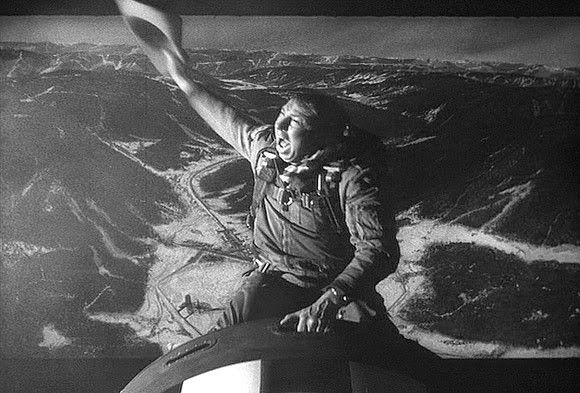
In film, arguably one of the best examples of "satire" is "Dr. Strangelove, or How I Learned To Stop Worrying And Love The Bomb" by Stanley Kubrick. The film is also often called a "black comedy", but "satire" works here too. The film is absurd and extremely funny in spots, but, when taken in context with the time it was made, the "satire" becomes apparent. It was released at the height of the Cold War, when people were either terrified at the prospect of nuclear destruction, or had become complacent to it, or actually advocated it in the hope that one side could survive it if the side struck first and hardest before the other side could retaliate. The realization that there was no possibility of survival of a nuclear strike is shown in the image at left with Slim Pickins, a good ol' redneck boy who believes in America and is part of the war machine, riding a bomb down to his ultimate destruction on the Russian landscape below. The film, as mentioned above, was absurdly funny, but also helped people to understand that nuclear war was unwinnable and that only Mutually Assured Destruction kept the two superpowers from unleashing their nuclear arsenals, despite the best efforts of war mongers to do just that. Again, a positive outcome from a satirical work of art.

So, now we come to modern satire. Indeed, there are many examples of good modern satire. But too often, "satire" is invoked for something else. The "something else" can be low-brow, boorish, sophomoric, insulting, degrading, humiliating, offensive, and repugnant. What's missing is the intent to bring about positive change. A debate could ensue as to what constitutes positive change, but most reasonable people know what that means. Unfortunately, we have too many examples of what passes for "satire" that is actually an excuse to crassly mock something that they just  don't like. Facebook uncovers a particularly nasty example I would like to share.

Behold, the facebook page entitled "Breaking Obama." If you look closely at the cover page, on the left, you'll see the word "satire" appear. I invite you to peruse the rest of the page. I did and I wanted to throw up. One could argue that the page is a free expression of people who happen to disagree with the current US President. If it were only that, I could accept it. But go farther on the page, and other things begin to appear. I won't describe what those things are: they are apparent to most reasonable people. What I wish to show is that this is NOT "satire".  It is, quite simply, trash. There is no effort to use the irony or even mockery to bring about positive change. If the people who post on this page want to disagree with President Obama, that's one thing, and that's quite acceptable and even desirable for the sake of democracy. Those people would see a positive change in the electoral defeat of Obama. Fair enough. But that ship has sailed: Obama is the legally and duly elected President of the United States. These people do not accept this and choose to vent their displeasure in rather vile ways. Folks, this is NOT "satire".

I re-assert my position in the preceeding blog entitled "The Trouble With Charlie". If we want to use free speech properly, we need to be responsible about it. And we constantly have to examine the intent of speech that is critical, ironic, sarcastic, and mocking. If the intent is to bring about positive change , then I am on board fully and completely. But if the intent is otherwise, then I reserve the right to call it what it is.

In the case of Charlie Hebdo, I refuse to look. I think I know enough about it to defend my case. If there are readers of mine out there who have examined Charlie Hebdo, and can prove that it is indeed "satire", please let me know. And we can continue the debate.

Tuesday, January 13, 2015

THE TROUBLE WITH CHARLIE

The images and sounds are not soon forgotten. Masked men emerging from a car, a lone policeman, already wounded, pleading for his life, as a gunman runs up to him and abruptly ends the policeman's life : sporadic gunfire is heard. Muffled noises fly up to the rooftop. Confusion, chaos and death in the afternoon. All because of some cartoons.

In the time after the massacre at Charlie Hebdo, there have been world wide words of condemnation, mass rallies and demonstrations, endless commentaries from TV talking heads who make their living from calamity, and world leaders walking arm in arm down the Champs Elysee.  Those who see this as an assault on free speech have had a field day.

That would be scanned.

Up until last week, I had not heard of Charlie Hebdo. I assume that you had not either. What I have learned about Charlie Hebdo since the massacre hasn't made me shed any tears. I have not posted "Je suis Charlie" on my facebook page, nor have I walked the streets in my town brandishing a pen over my head. There's just something not quite right with all the hand wringing and wailing over this.

To be clear, and to cut off any knee jerk criticism of what I've just written, let me say, in the strongest terms I can, that I deplore the violence on that day. No person deserves to be shot in the street or in an office building just because of cartoons. Just as I believe that no person deserves to be shot in a school, a shopping mall, a movie theatre, in their home, in a market, or any place else.  I believe no person deserves to die in a rocket attack, a drone strike or from a home-made bomb placed in a public place by some deranged extremist.

So, now that I have made that declaration, a reader may be wondering why I haven't taken up the cause of Charlie Hebdo. The answer is because those at Charlie Hebdo, by constantly publishing those cartoons, were, in effect, taunting the extremists and daring them to so something. In other words, they were partially responsible for their own demise. Permit me to explain.

Those who have been claiming "Je suis Charlie" have done so in the name of free speech. They claim that the magazine had the right to publish what they wanted, no matter how satirical, because France, like all western countries, has a tradition of tolerating free speech as an expression of the democratic rights we all claim to enjoy. They claim that the attack was, therefore, not just an attack on the magazine, but on all of us.


They are only partially correct. Indeed, we have the right of free speech, just as we enjoy so many other rights in our society. But what "Je suis Charlie" conveniently neglects to consider is this: with rights comes responsibility. If a person or magazine or any other institution insists on exercising their rights, be it free speech or any other, they must take into account their responsibility to others in exercising that right. And they must recognize that, if they act or speak irresponsibly, there are consequences.

Let me once again state that I do not, nor ever will, claim that Charlie Hebdo "got what they deserved" or "got what was coming to them".  No act of violence can ever be condoned.

But Charlie Hebdo had to have known that continuous satire, designed to inflame, irritate, taunt, ridicule and insult, would have consequences. Had Charlie Hebdo been content to make its point, do it once or twice, and leave it alone, the massacre may never have happened. We will never know for certain.  But, we do know that they were warned constantly about reprisals and must have known that radicals and fanatics would try to get back at them. Yet, they continued to mock and give the middle finger. They continued to defy those who suggested that they tone down the rhetoric or stop using the images that were a red flag to others. They insisted that they had the right to express themselves. Some say that Charlie Hebdo was courageous. I say that they showed no responsibility with their right. I say that they were either stupid or arrogant with their apparent unassailability. I say that they were more tragic than inspiring. With their hubris came a terrible nemesis that is sad and not surprising.

One has to ask: what was the intent of Charlie Hebdo's campaign of satire? To educate? Educate whom? Most reasonable people understand the situation involving extremism. The only education available here was to those who enjoy the mockery and insult: Charlie Hebdo was providing them a shield for their mockery, the shield of free speech. So, what other purpose could there have been for the continuous mockery? To promote greater harmony or understanding among people? Hardly likely. To get people to laugh at themselves? Some people weren't laughing, obviously. Those who were laughing did so with derision and hurtful intent. Was it to sell magazines? No doubt about this. Or maybe the purpose was to deliberately provoke those who took offense. To degrade, dehumanize, insult and demonstrate hatred of a group of people. If this is true, the right to free speech seems more a sham, more of an excuse to bully and intimidate. The only surprise is that the retaliation took as long as it did.

Free speech as a defense for improper or inappropriate words or actions is a slippery slope. In our country, we have had examples of those who attempted to spread hatred, venom and suspicion against others, all under the banner of free speech. I urge you to google and research the names of Ernst Zundle and James Keegstra as examples. It is possible that Charlie Hebdo might fall under the same category as those infamous men.

Voltaire once famously said "I may disapprove of what you say, but I will defend to the death your right to say it."  Inspiring words, aren't they? And we should all follow the principal behind them. But missing from this is the notion that the person speaking the words of which Voltaire disapproved must exercise responsibility for those words. Otherwise, all bets are off.

Thursday, December 18, 2014

THE COLD WAR IS OVER ?

I have been going to Cuba for several years now and have recently gone "off the resort" to get glimpses, however small, of life for the Cuban people. My love affair with the island and its people has only grown because of these visits, and I have blogged about them and shared my thoughts with you. We have noticed changes for quite some time now and we have been anxious to watch and take note of these changes and how they affect the Cubans and also our place as tourists in that country. The pace of change, while noticeable, has been measured and careful. Until now.

Yesterday's announcement by
President Barack Obama and President Raul Castro was the announcement we had all been waiting for. We knew it was coming: it was only a matter of time. But it certainly took us by surprise and has created quite a stir on twitter and facebook.

I have a Cuban friend who now lives in Canada. He used to work at the resort we affectionately call our "Cuban cottage". He left that job for greater opportunities in Canada and married a Canadian girl as well. Yesterday, he was ecstatic with the news. Finally, he said, the Cuban people will be able to have more. He spoke eloquently about how difficult life is for Cubans, and how hard it is to do even the simple things, like feed your kids or put shoes on their feet or clothes on their backs. His words were happy but also profound and impactful.

I also have many Canadian friends who have been messaging about this. While happy for the Cuban people, they worry that our little corner of paradise will be changed forever, and not for the best. We go to Cuba for the obvious reasons: sun, warmth, beach, booze and fun. But we also go because, like me, everyone who goes there falls in love with the island and the people. We love their friendly charm and their positive outlook and strength in the face of adversity. We admire their courage and feel proud of their accomplishments, all done in the face of hostility from the United States.

There's no question that yesterday's announcement will signal more profound changes to come. But we must all keep our perspective and maintain a sense of reality. If the Cuban people think that the announcement will bring instant prosperity, if they believe that good paying jobs will be at their finger tips, if they believe that consumer goods that we take for granted will be filling up the shelves in their shops, they are sadly mistaken. All they need to do is to look at other Caribbean nations, such as the Dominican Republic or Haiti or Jamaica. These nations have trade and investment with the US. There is still crushing poverty and reduced expectations for the bulk of their people. True, there is wealth in those nations, but it is only for the select few. Cuba will be no different.

And we tourists must keep a sense of reality. Cuba will continue to change, but the change will continue to be managed by the Cuban government. We will not see McDonald's restaurants popping up on every corner. We will certainly see American tourists at "our" resorts, but not in great numbers at first: too many Americans still see Cuba as hostile territory. Some Americans will arrive right away, but mainly for curiosity. More will arrive, but, hopefully, the tourist infrastructure will improve to absorb them. And, in this way, more jobs will be available for the Cubans. Not great paying jobs, but jobs nonetheless.

Yesterday's announcement was indeed historic. The reaction by Cuban Americans, largely based in Miami, and Republicans generally, was predictable. They are lashing out at Obama as being a traitor for even speaking to a Castro. They hold the Castro brothers in complete contempt and want their heads on spikes. These are the people the Cubans and Canadian tourists should be worried about. If they attempt to go to Cuba in large numbers, it will not be to go to reunite with family or spend quality time at a nice resort. It will be to foment anger and discord, to speed up the change until it erupts in chaos, all allowing them to exact their revenge on the old revolutionaries who chased them or their grandparents out of Cuba fifty years ago. This is the potential danger for all of us. Civil war ? Not out of the question. The Miami based Cuban Americans have been like angry dogs on a short leash for half a century. They are ready to be let loose, where the cry of havoc may be real.

We must be wary and hopeful. Of course, we wish nothing but the best for the people of Cuba. But the Cold War is not dead. Not by a long shot. After all,  Fidel and Raul are still with us, at least for a little while yet.


Friday, September 19, 2014

A NEW BRITAIN?

Nothing is certain in life: we all generally subscribe to this bromide. But certain things can be predicted with some confidence, based on past experience. Now that the votes in the Scottish independence referendum have been counted, and Scotland has voted quite clearly to remain in the United Kingdom, some things are bound to happen.

Britain can learn from the Canadian experience. In recent times, the Province of Quebec has gone down the same path as Scotland: the most recent referendum, in 1995, saw the sovereignty movement lose by the narrowest of margins, approximately 51% to 49%. Quebec is still in Canada, but there are some truths that Britain must learn from.

First, it would be wrong for Britain to assume that the independence movement in Scotland is finished. Far from it. The tally from last night reveals that 1.6 million Scots voted for independence. That's 45% of the total. Further, the concentration of Yes votes around the Glasgow area indicates that there is a base for the independence movement to work from. Those who voted in favour of independence were willing to take a chance on a risky venture of which nobody knows the outcome. The 55% who voted to remain in the UK may have done so out of loyalty to the crown, the flag, and the union: or they may have done so out of uncertainty how the future independence would unfold. As Scots get used to the idea of a possible independent Scotland, they may well put these fears aside. Quebec soundly rejected sovereignty in the first referendum in 1980 by approximately 60% to 40%, but the 1995 referendum, as described above, was much closer.

Second, and related to the first point, the genie is very much out of the bottle. Britain can never go back to the comfortable, somewhat complacent nation-state is was prior to this referendum. Independence has been discussed for years. I remember the time that Lou and I travelled around Scotland in 1992. We ended up in a pub ( imagine that!) in Edinborough on a Friday night. The pub was crowded with the after work business folks. We got talking to a couple of well dressed business men and they were fascinated with the Canada/Quebec situation. When I broached the topic of possible Scottish independence, they both smiled and one of them said "It's a beautiful dream." These men were not wide-eyed radicals. Even back then, the thought of independence was an ideal worth striving for, but not thought to be really possible. Look at Scotland now. The past is gone forever.

Third, in the last few days leading up to the vote, a nervous No side brought out everything they had to try to keep Scotland in the union. Famously, the three main party leaders made a "Vow" to the Scots promising changes. That reminded me of the years after the first Quebec referendum when Brian Mulroney, to his credit, tried to bring Quebec into the Canadian constitution with the Meech Lake Accord. Mulroney, a Quebecker, knew that the first referendum meant that significant changes were necessary to keep separatism silent permanently, and he tried to do the right thing. Whether the accord was a good deal or not, historians will have to judge. The fact is, he tried to bring the changes Quebec wanted, and the rest of Canada said "no" to those changes. The result is that separatism has never really died in Quebec, and a second referendum followed that almost won. To this day, Quebec remains outside the Canadian constitution.

I bring this up to warn Britons that, if the government in Westminster does not live up to its famous "Vow", Scotland will try again. It has nothing to lose by doing so. The idea is tantalizing to many Scots. There are and have been grievances between Scotland and Westminster for decades. If Westminster comes through, then Scotland may not go ahead with a second referendum. But the changes for Britain will be staggering. Not only will Scotland get more powers from Westminster, the national government will have to do the same for Wales and Northern Ireland. And what of England? Will there be an English parliament with devolved powers? Why would England be content to continue to have important issues affecting it decided by politicians from Scotland, Wales and Northern Ireland, while those lands can make their own decisions? Britain may have to seriously examine the possibility of becoming a federal state, similar to Canada or Australia, and de-centralize power from London. And, if that happens, an actual written constitution will be necessary, the first in British history.

Britain would be well-advised to pay attention to the Canadian experience. In this sense, the mother will have to learn from her daughters.

Thursday, September 18, 2014

THE END OF THE NATION-STATE

Note: this entry was composed at approx. 4:30 pm on Sept. 18, 2014, roughly 40 minutes before the polls closed in Scotland. The results of the referendum were unknown at this time.

The modern nation state took its form in the eighteenth century. Depending on who you read, France is given as the earliest example of a modern nation-state. Since the French Revolution, France has undergone several changes, some very violent, before settling on the entity we have today. Since the eighteenth century, the world has created untold versions of the nation-state, but the consistent thing in all of this is that the nation-state is regarded as the most advanced and most modern political expression of humanity's will to live and work together as a cohesive unit.

Simply put, a nation-state is a political organization that derives its authority from a sovereign people. The nation-state may comprise several ethnic or cultural groups of people: several religions, several languages, several philosophies may exist within a nation-state. For example, before the French Revolution, there was no real idea of what "France" was. "France", in the middle ages, was the area surrounding the city of Paris: other people who lived in what we now call France identified themselves as Gascons, Bretons, Normans, Acquitanians, etc. Only through centuries of effort by strong monarchs and equally strong ministers such as Richilieu, Mazarin and others, did the far-flung regions begin to feel that they were part of something larger, something stronger, something more secure ... something that they began to call "French".  Other nations in Europe, notably Germany, Italy and Spain went through similar experiences.

In the Middle Ages, it was relatively easy to determine a "nation". If you shared an ethnicity within a defined geographical space, if you spoke the same language, if you worshipped the same gods, then you were a citizen of a nation. In England, all people eventually spoke English and worshipped in the same church. In Japan or Korea, all people living in those lands were of the same ethnic background. In the aboriginal history of North and South America, you knew you were Mohawk, Lakota, Maya, Quechua, Aymara or Inuit because the other people in your general land area were the same as you. But as the centuries unfolded, people began to overlap. Mohawks joined with Seneca and others to form the Six Nations Confederacy. Incas evolved out of a Quechua tribe conquering other tribes to forge an empire. Saxons, Bavarians, Westphalians and others fell into the Prussian influence to become Germans. And, as a result, nation-states were born. Over time, people took on the larger identities as explained above.

The key ingredient in forming the nation-state, besides the emotional and visceral feeling of being a "Frenchman", or a "German", or an "Italian", or any other nationality, is having a strong central authority to keep the nation-state together. In older times, this was usually in the form of a strong monarchy. Later, the authority was in a strong central or federal government. As long as the authority of the central government went unchallenged, the nation-state worked smoothly, and loyalty to the nation-state was unquestioned. But, occasionally, people or regions would begin to question the authority of the central government. That's when the nation-state began to totter. The best example of this is the Civil War in the United States. Other nation-states have endured brutal civil wars: Greece, Nigeria, Sri Lanka, many modern Arab and Middle Eastern nation-states come to mind. And when people decide to explore the dissolution of nation-states peacefully, separatist movements and referenda occur: Canada, the former Czechoslovakia, and currently the United Kingdom come to mind.

Which brings us to the present day. Events around the world seem to be heralding the demise of the nation-state. Not just politically, but economically and culturally, do we see people more willing to shed the narrow definitions of who they are. Politically, we may be on the verge of witnessing the historic dissolution of the United Kingdom if Scotland votes in favour of independence. In 1989, an equally unbelievable event occurred with the dissolution of the USSR into its several components. In the 1990's, Czechoslovakia went through the "velvet revolution", breaking themselves peacefully and willingly in half, forming the Czech Republic and Slovakia. Even stable and thriving nation-states such as the United States and Canada are fraught with division and disagreement that sometimes results in political paralysis. The nation-state of Belgium, one of the most stable states in Europe, famously went without a federal government for several years because the two major ethnic components, Flemings and Walloons, couldn't find a way to form a workable political coalition.

Perhaps the most insidious threat to the nation-state is economic in nature. The rise of multi-national corporations has been such that it is difficult to determine where a corporation's "country" or "home office" is located. Questions arise: to whom does a multi-national corporation answer or obey? Under what laws does a business operate? If a multi-national runs afoul of a nation-state's laws, does it simply shut down operations in that nation-state and relocate elsewhere? If workers try to organize or earn higher wages, benefits and pensions in one nation-state, does the multi-national have any obligation to allow this when workers in a different nation-state do not organize or earn higher wages etc? Do multi-national corporations make decisions based on the corporation's best interest, or in the best interest of a nation or a people?

So, as Scots today go to the polls to determine their place in the larger nation-state of the United Kingdom, we watch fascinated and a little apprehensive. But does the apparent demise of the nation-state mean disaster? Or is it a good thing? Nation-states, particularly strong ones, have caused wars and injustice throughout our history. Could smaller nations, possessing no large forces, or large egos, or external ambitions be the way to go? It has been suggested that the possibility of large-scale wars, like the world wars of the last century, could be a thing of the past since such wars are bad for business, and multi-national corporations are so inter-connected , so global in their outlook, that war would be unacceptable to the corporations. And people may evolve into feeling a greater loyalty for the world itself, given the ease with which we travel, the amount of global culture we consume, and the financial wealth we accumulate from the far corners of the world.

The end of the nation-state could be one of the most enlightened choices we, as a species, could ever make.